
Playing from within.
Biomechanics, neuroplasticity, and a new way to learn music without tension.
This book is ideal for musicians, singers, students and teachers who are looking to understand the relationship between the body, technique, emotion, learning and musical practice.
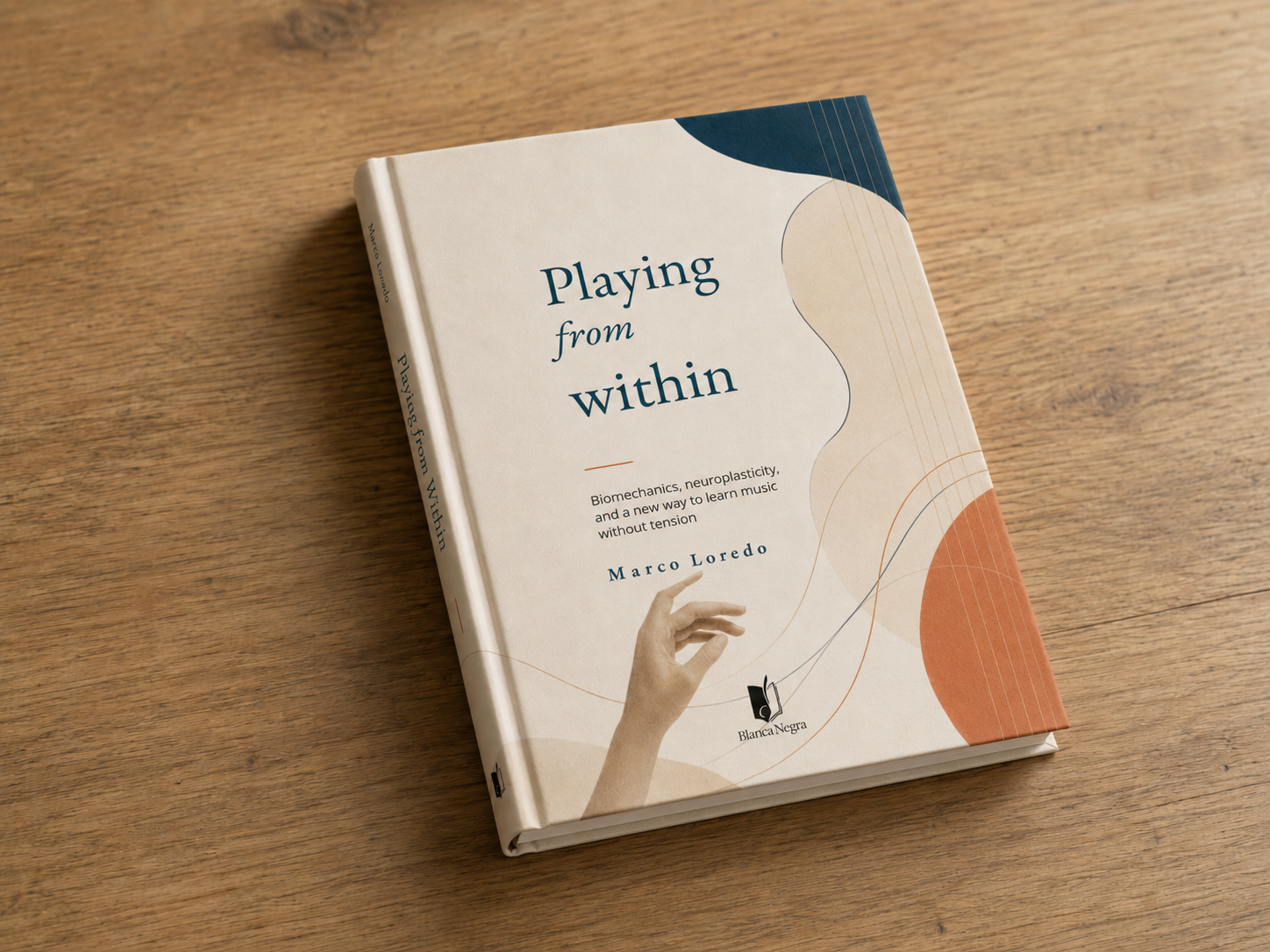
A book about the body, technique and the process of learning music.
'Playing from Within' stems from a specific question: Why does playing sometimes stop feeling natural?
Building on this question, the book provides reflections on the body, the nervous system, neuroplasticity, bodily memory, tension, emotion, musical practice and pedagogy.
It does not assume that playing better simply means practising more. Instead, it encourages you to observe how your body moves while playing, how your nervous system learns through repetition, and how you can develop a clearer, more conscious and more human relationship with music.
You might be interested in this book if...
It is designed for people who want to take a more integrated approach to music practice, considering the technical, physical, emotional and pedagogical aspects.
What you'll find in its pages:
The book provides an overview of the principles of this methodology, offering a comprehensive perspective on musical practice, from musician's dystonia and neuroplasticity to breathing, phrasing, emotion and teaching.
It also considers academic training, oral tradition, prevention and physical rehabilitation, as well as the potential for a more inclusive approach to music education.
- Dystonia and loss of control in musicians.
- The Body as an Instrument.
- Neuroplasticity and body memory.
- Distinguishing between useful and unnecessary tension.
- Excitement and motor control.
- Academic and oral traditions.
- Physical rehabilitation and prevention.
- An inclusive educational approach.
Book Contents
The book is divided into four sections.
The body and nervous system
Musician's dystonia; the body as an instrument; neuroplasticity; body memory; tension; and emotion.
Two traditions, one practice.
A reflection on academic education and oral tradition, and the potential for combining the two.
Rehabilitation and prevention
Methods for physical rehabilitation, prevention and functional recovery to support the musical process.
An inclusive educational approach
It is a way of studying, teaching and playing that draws on the body, awareness and musical sensibility.
Why I Wrote This Book
I wrote this book because, for a long time, I had been wondering why playing could stop feeling natural, why the body would sometimes resist, and whether pushing harder would always help.
Over time, I realised that many of the difficulties I encountered while playing were not just technical flaws, but rather learned ways of organising the body, attention, and nervous system.
This book is the result of that quest. It is based on personal experience, teaching and research, and is intended to provide a clearer and less forceful way of understanding musical practice.
This is an invitation to reconsider the relationship between musicians and their bodies.
What this book is not:
This book is not a quick-fix recipe book. It does not promise magical solutions and is not a substitute for specialised care when needed.
Nor does it seek to impose a single technique or absolute truth on how an instrument should be played.
Responsible reading
The book offers perspectives on pedagogy, physicality and music. It aims to encourage readers to ask questions, provide them with tools for observation and help them develop a more mindful practice.
Every musical and physical process is unique. For this reason, the ideas in this book are intended to provide guidance and food for thought, rather than offering a universal solution.
The book and methodology
The book provides a conceptual and reflective foundation for Tocar desde dentro. While it brings together the ideas that underpin the methodology, it does not replace personalised work, direct observation or adaptation to each individual case.
Reading the book can help you to develop a better understanding of the relationship between the body, learning and music. Applying the methodology enables you to put these ideas into practice when playing an instrument, singing, practising, or teaching.
- The book lays the groundwork for understanding.
- This approach can be applied to specific cases thanks to the methodology.
- They both share the same philosophy of playing with musical sensibility, awareness and from the body.
Playing from within
Biomechanics, neuroplasticity, and a new way to learn music without tension.
The book will be available to purchase on Amazon. Once it's published, you'll be able to access the purchase link from this page.
Playing from within
Biomechanics, neuroplasticity, and a new way to learn music without tension.
Marco Loredo
The book is a gateway. The practice begins with the body.
If you would like to apply these ideas to your instrument, voice, teaching or institution after reading this, we can work together.