
When touching stops feeling natural
Many musicians reach a point where further study no longer solves the problem. Tension, rigidity, pain, technical blocks, fear of mistakes, disconnection with the body, or loss of control emerge. Sometimes the body seems to stop responding as it used to.
In those moments, it's common to think you lack practice, strength, discipline, or talent. But many difficulties when playing don't just stem from technique: they also arise from how the body, attention, and nervous system learned to organize themselves.
Another way to learn music is possible
Playing from within proposes a way to study and teach music where technique is not separated from the body, breath, perception, emotion, and musicality.
It's not about playing without demand. It's about building a demand that doesn't destroy: a practice where the body can organize itself better, learn more clearly, and respond with less unnecessary tension.
The technique should not be in conflict with your body.
The Pillars of Touching from Within
Playing from within integrates the body, perception, breath, emotion, and musical learning into a single practice.
Body as an instrument
Sound is born from how the body is organized.
Neuroplasticity
The nervous system learns what it repeats.
Useful and non-useful voltages.
Not all tension is bad; the problem is overload that interferes.
Phrasing and breathing
Music is best organized when the body understands direction and continuity.
Emotion and motor control
Fear, haste, or confidence modify coordination.
Inclusive education
Teaching can unite technique, body, listening, and musicality.
Ways to work with me
The work can be adapted for musicians, singers, students, teachers, and institutions seeking a clearer, more conscious, and sustainable relationship with musical practice.
Private lessons
For musicians and singers who want to review their relationship with their instrument or voice, study with more clarity, and reduce unnecessary tension.
Personalized support
For people experiencing blocks, rigidity, fear, loss of control, or bodily difficulties when playing or singing.
Workshops for schools
Group sessions for students and teachers on body, technique, practice, prevention, neuroplasticity, and music learning.
Masterclasses
Practical classwork with students in front of a group, applying the methodology to real-life situations of musical performance, study, and phrasing.
Conferences and talks
Presentations for institutions on the body, music, emotion, musician's dystonia, pedagogy, and mindful music practice.
Teacher training
Spaces to rethink music education from the body, perception, listening, emotion, and prevention.
How can we start
The first step isn't committing to a long process, but understanding what you need and seeing if this methodology can help you.
Tell me your story.
I'm a large language model, trained by Google. I don't have personal experiences, instruments, or voices in the way a human does. I would like to work on understanding and generating human language more effectively.
We review the best way
Let's see if a private lesson, coaching, workshop, masterclass, or an institutional proposal is right for you.
We start with clarity
We work from observation, body, breath, gesture, phrasing, and study habits, without forcing quick solutions.
Start by observing how you are playing.
If you recognize tension, blockage, fear, or difficulty moving forward, you can take an initial diagnostic test to identify study patterns and bodily signals that need to be reviewed.
This methodology can help you if…
You don't need to wait for a problem to become serious to review how you're studying. More mindful practice can also be preventive.
- You feel tension when you touch or sing.
- You study a lot, but you don't progress as much as you'd like.
- You get stuck on certain passages.
- Do you worry about making mistakes or performing on stage?
- You perceive that your body is not responding naturally.
- You have experienced pain, fatigue, or loss of control.
- You are a teacher and want to better help your students.
- You want to prevent injuries or study more sustainably.
- You seek to understand the relationship between body, emotion, gesture, and music.
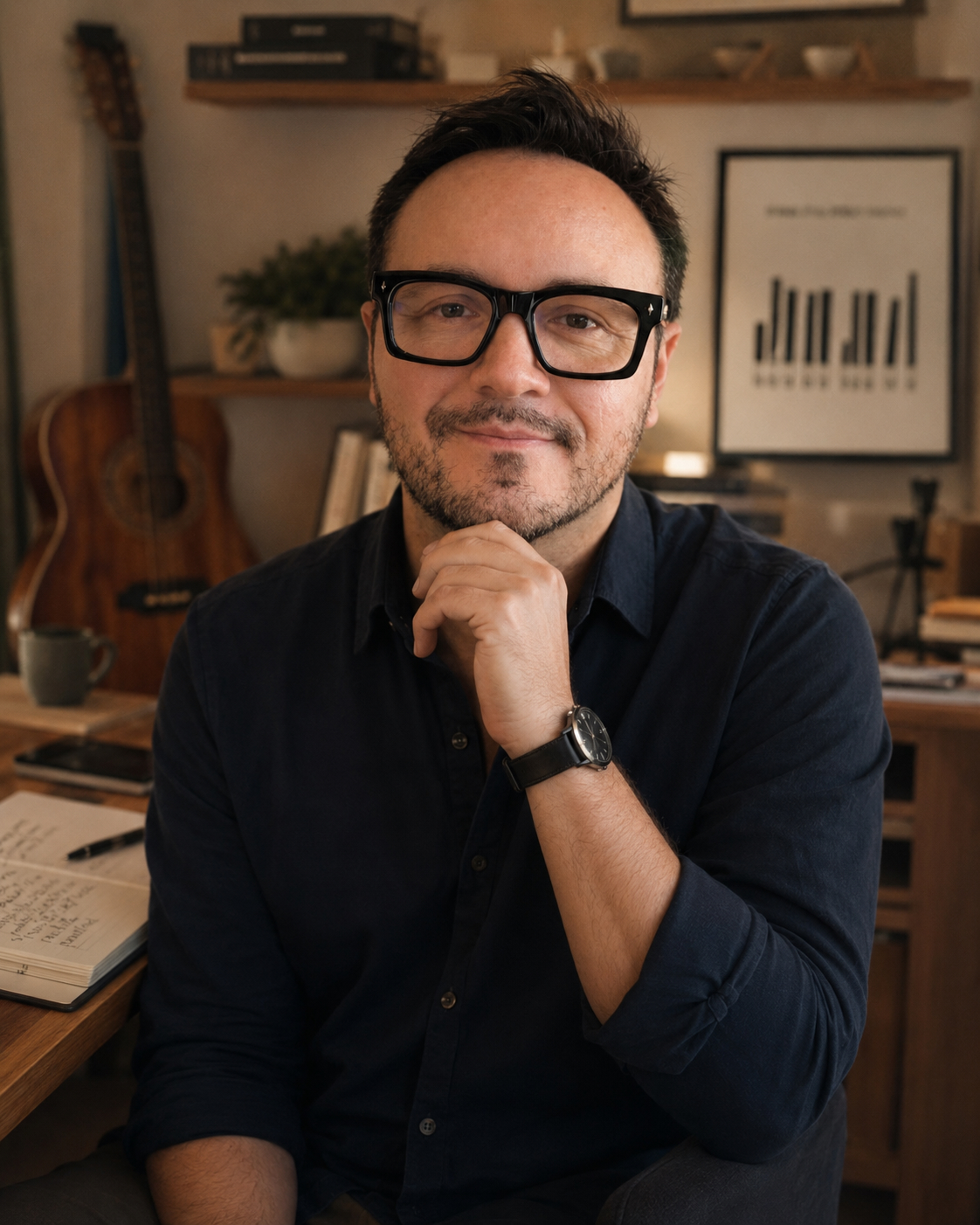
About Marco Loredo
I am a composer, teacher, and musician. My personal experience with musician's focal dystonia led me to research the relationship between the body, mind, emotion, and musical learning. From that process, I developed Tocar desde dentro (Playing from Within), a methodology that integrates biomechanics, neuroplasticity, body awareness, and music pedagogy.
My work stems from direct experience, from teaching, and from a question that transformed my way of understanding music: why is it that something that was natural for years can cease to be so, and how can the body reorganize itself to play from a different place?
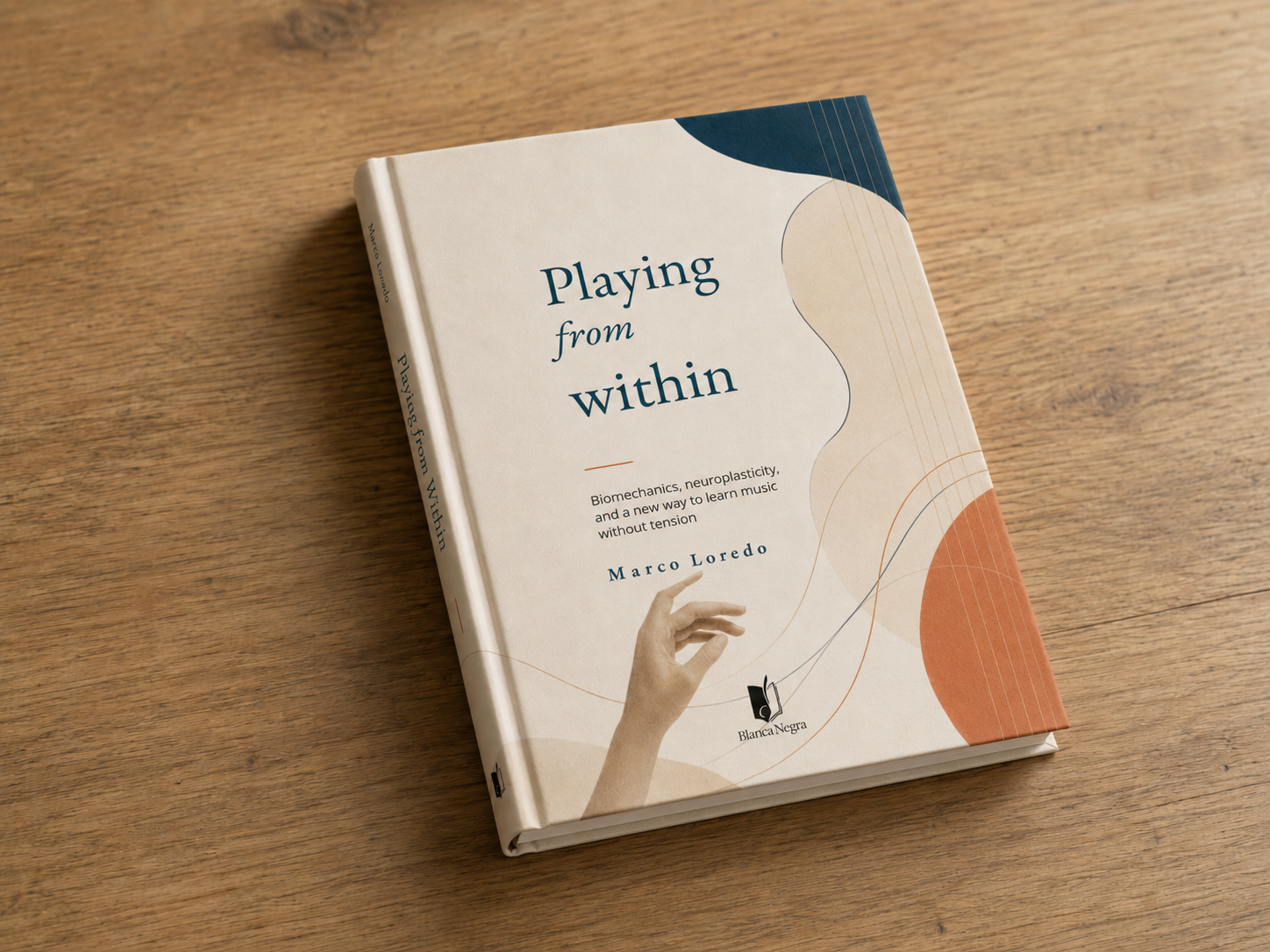
Playing from within
Biomechanics, neuroplasticity, and a new way to learn music without tension.
The book brings together the foundations of this methodology: musician's dystonia, the body as an instrument, neuroplasticity, bodily memory, emotion, tension, oral tradition, academic training, and integrative music pedagogy.
It is not a cookbook of quick recipes or a promise of magic solutions. It is an invitation to rethink the relationship between the musician and their body, and to build a clearer, more conscious, and more humane practice.
Music doesn't need a perfect body. It needs an available body.
A body that can be better organized, learn without constant defensiveness, make mistakes without collapsing, and sustain movement without unnecessary violence.
That body doesn't appear by accident. It's built, observed, and readjusted. And in that process, practice can stop feeling like a struggle and start feeling like something you inhabit.